For years, marketers have debated whether showing up in AI-generated answers actually does anything. Is it a vanity metric, or does it move the needle on real business outcomes like traffic, brand preference, and conversions?
Similarweb just published one of the first data-backed answers to that question. Their new study, “The Downstream Impact of AI Visibility,” tracks what happens to real users after they see a brand recommended in an AI response. The findings are hard to ignore and have significant implications for how brands should think about AI visibility as a channel in 2026 and beyond.
What the Study Measured and How
Similarweb used its proprietary real-user clickstream panel (US Desktop) to study user behavior across three consumer verticals – finance, travel, and beauty – between July and December 2025.
The methodology was carefully designed to isolate the true impact of AI exposure:
- Only users who had not visited the brand’s domain in the prior four weeks were included.
- Only users who did not mention the brand name in their initial AI prompt were tracked. These were genuine discovery moments, not people already looking for that brand.
- Downstream visits were tracked for seven days following the AI conversation.
The goal was to measure what happens when AI introduces a user to a brand they were not already seeking.
The Headline Finding: A 2.5x Lift in Visit Likelihood
The most striking number from the study is this: users are 2.5x more likely to visit a brand’s website within 7 days of an AI recommendation than of a direct competitor not recommended in the same response.
That is not a marginal edge. It positions AI recommendations as a genuine demand-generation channel, one that works on a delayed timeline that most standard attribution models completely miss.
It Is Industry-Specific, but the Pattern Is Consistent
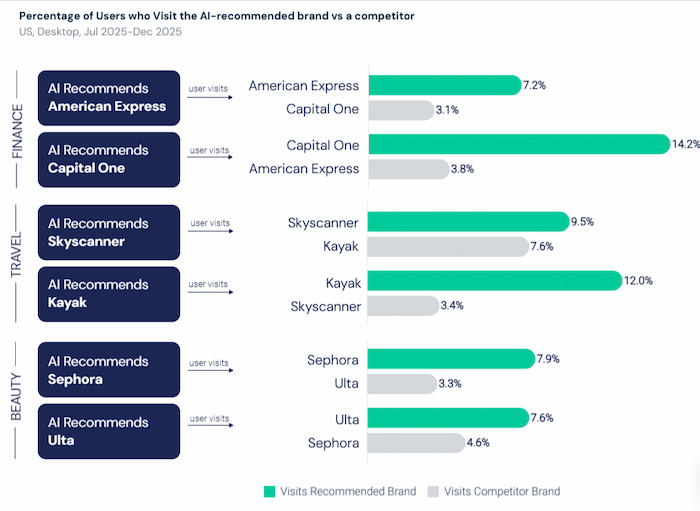
Similarweb drilled down into specific brand pairs across each vertical, showing just how decisive an AI mention can be.
Finance:
- When AI recommends American Express for credit card questions: 14.2% visit Amex vs. 3.8% visit Capital One.
- When AI recommends Capital One: 7.2% visit Capital One vs. 3.1% visit American Express.
Travel:
- When AI recommends Skyscanner: 12.0% visit Skyscanner vs. 3.4% visit Kayak.
- When AI recommends Kayak: 9.5% visit Kayak vs. 7.6% visit Skyscanner.
Beauty:
- When AI recommends Sephora: 7.9% visit Sephora vs. 3.3% visit Ulta.
- When AI recommends Ulta: 7.6% visit Ulta vs. 4.6% visit Sephora.
The pattern is consistent: the brand that wins the AI mention wins the traffic. And the flip side matters equally. When a competitor is recommended instead of you, the traffic shift is symmetrical. It moves to them. This is a zero-sum dynamic that makes AI visibility a competitive battleground rather than just a brand-building exercise.
The Traffic Channel You Did Not Expect: Direct and Branded Search
This is where the data gets particularly interesting for SEO and analytics professionals.
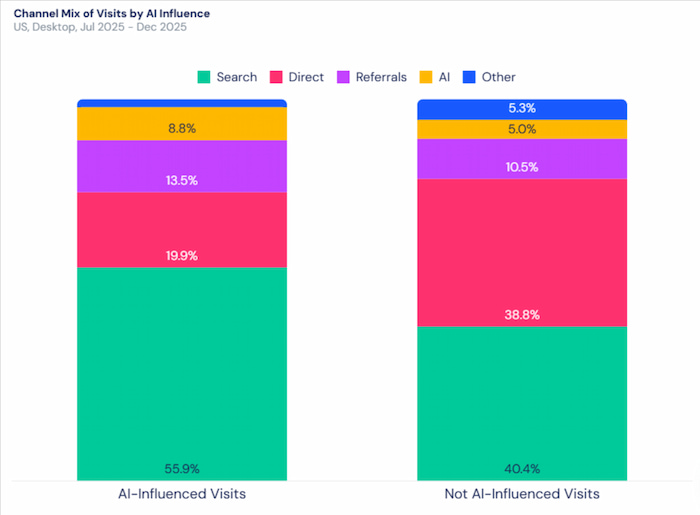
When users are influenced by AI, they do not arrive at a brand’s website by clicking an AI-generated link. Instead, over half (56%) of AI-influenced visits arrive via search engines, and a significant share come through direct navigation, meaning people type the domain name straight into their browser.
Rand Fishkin, co-author of the study and CEO of SparkToro, describes the mechanism plainly in his video commentary:
“If Capital One gets recommended as a credit card company, or your brand gets recommended for whatever you do by an AI tool, it is quite likely that someone will directly go to their browser and type in your domain name.”
The channel mix data backs this up. Compared to standard (non-AI-influenced) visitors, AI-influenced users show roughly 15% lower traditional search but higher direct traffic. The AI conversation serves as a memory trigger. Users do not click out of the AI interface. They close the session, think about it, and return later through their own navigation, either by typing directly or performing a branded search.
This has a critical implication for attribution: most analytics setups will never connect that direct visit or branded search back to the AI mention that caused it. The real impact of AI visibility is almost certainly being systematically undercounted across the industry.
These Visitors Arrive Convinced
AI-influenced visitors do not just show up in higher numbers. They behave differently once they arrive.
- They view nearly twice as many pages as standard visitors.
- They spend twice as long on site.
The reason is straightforward. These users have already done their discovery and comparison work inside the AI conversation. By the time they land on a website, the research phase is over. They have already narrowed their options and are arriving ready to act.
AI Owns the Top of the Funnel
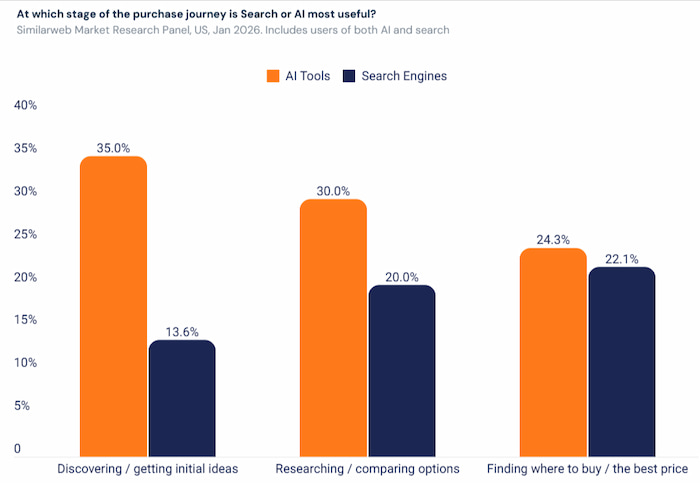
Survey data included in the Similarweb study asked users to compare AI tools and traditional search engines at different stages of the purchase journey.
| Journey Stage | AI Tools | Search Engines |
|---|---|---|
| Discovery and Initial Ideas | 35.0% | 13.6% |
| Researching and Comparing Options | 30.0% | 20.0% |
| Finding Where to Buy or Best Price | 24.3% | 22.1% |
AI dominates the early stages of discovery and research, while traditional search nearly catches up only at the final step of finding where to buy. The practical implication is that brands recommended during AI-assisted research are being added to the consideration set before the user even opens a search engine.
Fishkin adds an important caveat here. While people say AI feels more useful at the start of the journey, traditional search engines are still used roughly a hundred times more often across the consumer journey overall. The survey reflects perceived usefulness and preference, not raw volume.
Rand Fishkin’s Take: Think Outdoor Advertising
Fishkin’s framing of this data is worth sitting with. He draws a parallel to 20th-century outdoor advertising:
“This is a really similar approach to how advertisers did outdoor advertising in the twentieth century and traditional advertising, which is: presence equals later consumption and later brand preference.”
The implication is that AI visibility functions less like a performance channel, where you track click to visit to conversion, and more like a brand awareness channel. The impact accumulates over time, shows up in indirect metrics, and is nearly impossible to trace with standard click-based attribution. The brands building their AI presence now may be creating durable consumer preference that compounds quietly and becomes visible only once the market catches up to them.
The Open Questions
Similarweb and Fishkin are both transparent about what this study does not yet answer.
Would these users have found these brands anyway? It is possible the AI recommendation simply accelerates an inevitable discovery for already-likely buyers.
Does this hold for smaller or unknown brands? The study focused on large, recognizable consumer brands. The effect may be different for brands without existing awareness.
How does AI visibility compare to other channels? Would ranking first in Google or appearing in a widely watched social media video drive a comparable lift? There is no apples-to-apples comparison yet.
These are legitimate caveats. But as Fishkin puts it: “I think AI probably is influencing visits to almost everyone. It’s small right now. It’s probably growing. It’s probably big in some sectors and quite tiny in others.”
What This Means for Marketers
A few practical takeaways from this research:
Treat AI visibility as a real channel. The data shows measurable downstream impact on traffic and brand preference. If you are not tracking your AI mention share, you have a blind spot in your marketing picture.
Your attribution is likely undercounting AI’s impact. If AI-influenced users arrive primarily via direct and branded search, your current models are attributing that traffic to the wrong source. Consider auditing how your analytics handles this.
Getting recommended is a competitive issue. The zero-sum nature of AI recommendations means your competitor’s gain is directly your loss, not just in AI referral clicks but in downstream direct and search traffic too.
Know your audience’s AI behavior. Fishkin notes that higher-income, higher-education audiences and those making considered purchases tend to skew more toward AI use. Do not draw broad conclusions without understanding where your specific audience sits.
Measure your AI visibility actively. Tools like Similarweb’s AI visibility tracker, SEMrush, and Gumshoe can help you understand whether your brand is appearing in AI responses and whether that trend is moving in the right direction.
Bottom Line
Similarweb’s research is one of the most rigorous attempts yet to put hard numbers behind a question the entire marketing industry has been circling: does AI visibility actually drive business outcomes?
For consumer-facing brands in finance, travel, and beauty, the answer appears to be yes, measurably and meaningfully, and in ways that go well beyond what standard analytics can capture. AI mentions drive direct visits, branded searches, and deep on-site engagement from users who arrive already primed to act.
The brands building their AI presence today may be building consumer preference advantages that compound quietly and become very visible to those around them only later.
Sources: