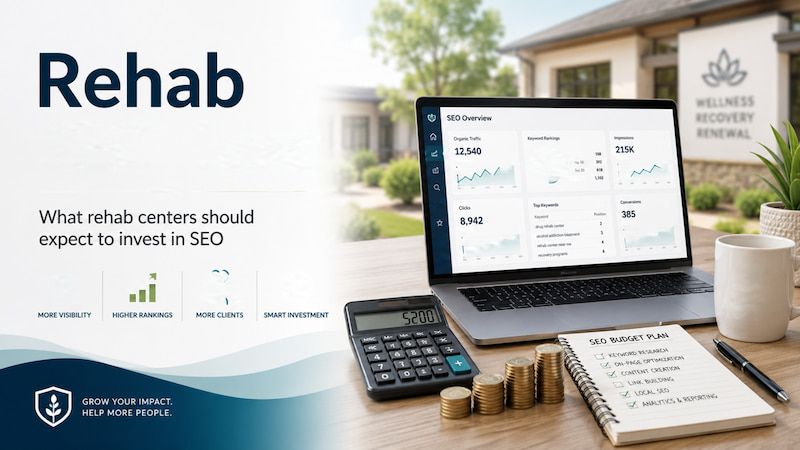
Short answer: In 2026, a single-location treatment center should expect to pay $2,500 to $5,000 per month for a credible SEO retainer. Regional multi-location providers typically pay $6,000 to $15,000 per month, and national networks pay $15,000 to $50,000 or more. Most single-facility US centers land between $2,000 and $8,000 per month, and roughly 73% of addiction treatment centers sit inside that band. Anything materially below $2,000 per month is almost never real rehab SEO. It is a content mill.
That number, on its own, tells you very little. A $3,000 retainer and a $12,000 retainer can both be fair or both be theft depending on what is inside the scope, how competitive your market is, and whether your facility can convert the traffic. This guide breaks down what each tier actually buys, why rehab costs more than almost every other industry, what the individual components should cost, and the only calculation that matters: what the retainer needs to return to be worth signing.
The 2026 Rehab SEO Retainer Benchmarks
Pricing in this niche is consistent enough across sources to form real tiers. The boundaries are not arbitrary. They map to what the work costs to produce at each scale.
| Tier | Monthly Range | Facility Profile | Content Cadence |
|---|---|---|---|
| Entry / Local | $2,500 to $5,000 | Single location competing in one metro market | 2 to 4 pages per month |
| Mid / Regional | $6,000 to $15,000 | 3 to 10 facilities, or one facility in a saturated market | 6 to 12 pages per month |
| Enterprise / National | $15,000 to $50,000+ | Multi-state networks, 10+ facilities, or premium national brands | 15+ pages per month |
| Danger floor | Under $2,000 | Not a tier. Offshored content or link schemes. | Automated, unreviewed |
Other operators in the space quote ranges that overlap heavily with these. One puts a dedicated addiction treatment SEO program at $3,500 to $10,000 per month. Another reports the market spanning $1,500 to $15,000 or more, with the average facility spending $2,000 to $8,000. A specialist covering court-ordered treatment programs, a narrower and more regulated niche, quotes $4,000 to $12,000 per month and notes that providers quoting below $2,500 rarely include the legal and compliance content review the niche requires.
The convergence is meaningful. Independent of who is quoting, the floor for defensible work sits around $2,500, and the band where most real single-facility and small-group programs operate runs from roughly $3,000 to $8,000.
A note on geography and currency. UK and European pricing follows a different curve. One award-winning UK rehab SEO agency quotes £3,000 to £15,000 per month and standardizes on a six-month minimum retainer. Do not convert those figures and compare them directly to US quotes. Market competition, content labor costs, and regulatory context all differ.
Program type shifts the number too. Detox, residential, outpatient, and IOP or PHP programs compete for different keyword sets with different competition profiles. Residential and luxury programs chase higher-value, more contested national terms. Outpatient programs are more locally defensible and often sit at the lower end of the range.
The Rehab Premium: Why It Costs More Than Normal SEO
Here is the comparison almost no pricing article in this niche makes, and it is the most useful context available for judging a quote.
Across all industries, independent survey data puts the average SEO agency retainer at $3,209 per month, based on a poll of 439 SEO professionals. Clutch’s April 2026 data lands almost identically at $3,199 per month. In the same dataset, the single most common monthly fee sits between $501 and $2,000, covering roughly 43% of respondents.
Put those side by side with the rehab tiers and the premium is obvious. The entry-level floor for treatment center SEO sits at or above the cross-industry average. Mid-tier rehab retainers run two to five times that average. A single-location rehab paying $4,000 per month is paying more than most businesses in most industries pay for national campaigns.
There are concrete reasons for the gap.
YMYL classification. Treatment center content falls into Google’s “Your Money or Your Life” category, where content can affect a person’s health, financial stability, or safety. Rehab hits all three. Google applies its highest content-quality bar to these pages.
Clinical review labor. A roofing company can publish a 600-word storm damage post written in ninety minutes. A treatment center publishing a page on how to recognize alcohol use disorder needs accurate citation of medical sources, an author bio signaling credentialed expertise, clinical review, and content depth sufficient to satisfy an algorithmically suspicious bar. The labor to produce one credible rehab page is a multiple of the labor to produce one credible page in a normal industry, and that shows up in the retainer. Healthcare-specific costing puts a single detailed clinical service page at $200 to $400 to produce properly.
Compliance engineering. HIPAA-safe analytics, call tracking covered by a Business Associate Agreement, no remarketing on patient lists, no protected health information in URL parameters. These are constraints a general agency never encounters, and they bake real engineering hours into every program.
Claim review. Rehab content has to avoid unsupported promises and vague outcome language. Google restricts advertising for recovery-oriented addiction services under its healthcare policy, and the major ad platforms require LegitScript certification for US addiction treatment advertisers. Even on the organic side, the review process for sensitive treatment claims adds time before publication.
Competition density. Treatment is one of the most contested verticals in search because patient lifetime value is high and well-funded operators, directories, and aggregators occupy the results.
One more supply-side signal worth knowing: 56.2% of SEO agencies are raising prices in 2026, with roughly 26% holding steady. The narrative that AI tooling is deflating agency pricing is contradicted by what agencies are actually doing. If you are budgeting for next year, budget upward, not flat.
What Each Tier Actually Buys
The difference between a $3,500 retainer and a $12,000 retainer is not three times the blog posts. It is a different scope of work entirely.
| Scope Area | Entry ($2.5K-$5K) | Mid ($6K-$15K) | Enterprise ($15K+) |
|---|---|---|---|
| Technical SEO | Maintenance, basic schema | Ongoing work, advanced schema | At scale, custom schema |
| Google Business Profile | 1 to 3 locations | Expanded multi-location | Network-wide with governance |
| Local citations | Foundational build | Expanded plus corrections | Authority-tier campaigns |
| Content production | 2 to 4 pages/month | 6 to 12 clinically reviewed pages/month | 15+ pages/month, full engine |
| Link acquisition | Minimal | Real acquisition work | Ongoing, integrated with PR |
| Digital PR | Not included | Some | Ongoing, tier-one media |
| CRO | Not included | Included | At scale |
| Attribution | Basic call tracking | Reporting tied to admissions | CRM and call-tracking integration |
| AI Overviews / AI Mode | Not included | Emerging | Fan-out query planning, citation share |
| Account leadership | Account manager | Dedicated lead | Senior strategic oversight |
Entry tier buys foundational visibility in one defined service area. Most of the work goes into Google Business Profile optimization, local citations, technical site health, and getting core service pages built before blog content, because that ordering produces admissions fastest at single-location scale.
Mid tier is where most regional treatment center groups land, and where topical authority becomes achievable within roughly twelve to eighteen months. It layers in higher-volume clinically reviewed content, genuine link acquisition, conversion rate optimization, multi-location local work, and reporting that ties organic traffic to admissions rather than sessions.
Enterprise tier funds a real content engine, ongoing digital PR targeting tier-one media, attribution infrastructure integrated with your CRM and call tracking, technical SEO at scale, and query planning for AI citation share.
Two rows in that matrix deserve extra scrutiny when you read a proposal. Link acquisition is the line most often sold as included and delivered as nothing. Digital PR targeting real media does not happen at the $3,500 per month level, regardless of what the proposal claims. Pin down deliverable counts and terms for both before signing.
A useful heuristic: cheap retainers tend to be reporting-heavy and execution-light. Strong retainers reverse that ratio.
What the Individual Components Cost
If a bundled retainer feels opaque, price-check it against the going rate for individual components. These are the current market ranges.
| Component | Typical Cost |
|---|---|
| Google Business Profile management | $200 to $500 per month |
| Local citation building or cleanup | $300 to $1,000, usually one-time |
| Review generation and management | $150 to $400 per month |
| Clinical service page (each) | $200 to $400 |
| Technical SEO audit | $5,000 to $20,000 |
| Site migration | $10,000 to $50,000 |
| Structured data implementation | $3,000 to $15,000 |
| Emergency or penalty recovery work | $200 to $500 per hour |
| Third-party tool pass-through | $50 to $300 per month |
| Focused local-only campaign | $750 to $2,000 per month |
Hourly benchmarks are also useful for sanity-checking. Independent survey data puts freelancers at roughly $72 per hour, agencies at $99, and consultants at $171. That gives you a reverse-engineering test: if an agency quotes $5,000 per month and estimates twenty hours of work, the effective rate is $250 per hour. That rate is defensible only if the specialization genuinely warrants it, which in clinically reviewed YMYL content it sometimes does. Ask the question and make them answer it.
On hourly billing generally: it is uncommon in the rehab SEO space and is usually a yellow flag. Treatment center SEO is a long-arc investment, and hourly billing tends to reward agency activity over client outcomes.
The Only Number That Actually Matters
The question every treatment center executive should ask before signing is not what the retainer costs. It is what the retainer needs to return to be worth it.
That calculation has three inputs: your retainer, your lifetime value per admission, and the number of admissions the program produces.
Lifetime value per admission for most behavioral health facilities sits between $15,000 for outpatient and $50,000 for residential, depending on length of stay and payer mix. Luxury residential facilities can clear $80,000 to $200,000 per admit.
From there, the break-even math is simple arithmetic.
| Monthly Retainer | Annual Cost | Break-even at $20K LTV | Break-even at $30K LTV | Break-even at $50K LTV |
|---|---|---|---|---|
| $3,500 | $42,000 | 2.1 admissions/year | 1.4 admissions/year | 0.8 admissions/year |
| $6,000 | $72,000 | 3.6 admissions/year | 2.4 admissions/year | 1.4 admissions/year |
| $12,000 | $144,000 | 7.2 admissions/year | 4.8 admissions/year | 2.9 admissions/year |
| $25,000 | $300,000 | 15 admissions/year | 10 admissions/year | 6 admissions/year |
Read that table carefully, because it reframes the entire conversation. A $12,000 per month retainer covers itself with five admissions per year at a $30,000 LTV. Break-even is not the goal. It is the floor, and a functioning program clears it inside the first quarter or two.
What does a working program actually produce? Thirty to one hundred admissions per year from organic search, depending on facility size and market. At the low end of that range against a mid-tier retainer, you are looking at a return in the high single digits to low double digits. A $12,000 monthly retainer that produces six admissions per month at a $50,000 LTV is a 24x multiplier. A $3,000 retainer that produces nothing is a $36,000 annual expense with no offset. Pricing is downstream of program quality, not the other way round.
Timeline. Local programs typically show measurable visibility gains in three to six months and meaningful admissions impact in six to nine. National programs take nine to eighteen months to fully express. Healthcare SEO more broadly follows the same arc: an audit and foundation phase in months one and two, content and link execution in months three to five, and patient acquisition compounding from month six onward.
The conversion caveat is not optional. SEO drives traffic. Your website, your intake team, and your clinical capacity convert it. If your site converts at 0.5%, doubling your traffic still only doubles a weak number. Conversion infrastructure has to exist before SEO ROI can materialize. This is the single most common reason a technically successful campaign produces disappointing admissions.
The paid media comparison. Many outpatient centers spend $30,000 to $50,000 per month on Google Ads to maintain stable lead flow. SEO usually costs far less monthly and keeps working after publication. Over three years, $10,000 per month in PPC is $360,000 spent with no residual asset, while the same spend on SEO builds content libraries, technical infrastructure, and authority that continue producing after the investment slows. This is not an argument against paid media, which buys speed that SEO cannot. It is an argument for understanding that you are buying two different things.
The Danger Floor: What Cheap Rehab SEO Actually Buys
Below roughly $2,000 to $2,500 per month, the unit economics of compliant rehab SEO do not work. Treatment center content requires clinical accuracy, author credentials, original analysis, and depth that takes hours to produce. An agency selling rehab SEO for $1,500 a month is publishing AI-generated content with no clinical review, no real link acquisition, and a set-it-and-forget-it approach that quietly burns twelve months before anyone notices.
What disappears from a cheap quote is predictable, and each omission carries a later cost.
| Cut from the quote | What it costs you later |
|---|---|
| Technical review | Hidden site problems persist and cap every other effort |
| Original content | Treatment pages stay thin and never rank |
| Local depth | City targeting exists on paper but produces nothing |
| Tracking and attribution | You never learn which inquiries came from organic |
| Authority work | Competitive rankings stall indefinitely |
| Claim review | Sensitive content risk rises, along with regulatory exposure |
The specific warning signs to watch for in a proposal or sales call:
Guaranteed rankings. No credible firm guarantees positions. Google’s ranking system is not contractually predictable. “Page one in 90 days or your money back” is a sales tactic, not a strategy.
One agency, dozens of rehabs. Some agencies run forty treatment centers through the same content workflow and produce essentially identical pages with city names swapped. You can identify this in about ninety seconds by comparing the agency’s client list against the sample pages they show you.
AI-mill content with no named reviewer. If the agency cannot tell you who reviews each clinical page and what their credentials are, you are buying generic AI output in a category where Google applies its harshest scrutiny.
No attribution conversation. If the proposal never explains how organic traffic will be tied to actual admissions, you are buying traffic that may or may not move the business.
A portfolio that is mostly link building. Backlinks matter, but they are one input. Programs that are 80% link acquisition tend to be the cheapest to operate, which is precisely why some agencies sell them.
The compliance risk deserves separate emphasis. Low-cost providers frequently rely on tactics that violate search engine guidelines: spammy link building, keyword stuffing, private blog networks. A penalized domain can vanish from search entirely, and recovery takes months or years. In a category where your admissions pipeline depends on organic visibility, that is not a marketing setback. It is an operational crisis.
When SEO Is the Wrong Spend Entirely
An honest pricing guide has to include the cases where the answer is “do not buy this yet.” There are four situations where the math does not work regardless of how good the agency is.
You are planning to sell the facility within twelve months. SEO compounds over time. The buyer benefits from the work, not you. There may be a valuation argument, but the timeline is misaligned with a near-term sale.
Your intake team cannot return inquiries within an hour. The treatment center conversion window is short. If inbound leads wait twenty-four hours for a callback, paying for more leads is paying for waste. Fix the intake operation before funding demand generation.
Your beds are already full with no expansion plan. Obvious when stated, routinely ignored in practice. A fully booked footprint should be investing in retention, alumni programs, and brand equity, not top-of-funnel lead generation that produces inquiries you cannot admit.
You are a brand-new facility with no operational data. SEO works best when there is a functioning sales motion to feed. Getting the technical foundation right before launch is smart. The larger spend should wait until you have intake processes and conversion data to optimize against.
There is also a cash-position test that cuts across all four. If your facility cannot absorb six to twelve months of investment before payback, SEO is probably not the right channel right now, and paid media is the faster path.
A good agency will tell you when you are in one of these situations. A bad one will sign the contract anyway.
How to Set Your Own Budget
Two approaches work, and they are best used together.
Anchor to revenue. Healthcare budgeting benchmarks suggest early-stage practices under $500,000 in annual revenue allocate 8% to 12% of revenue to digital marketing, growth-stage practices between $500,000 and $2 million allocate 6% to 10%, and established practices above $2 million allocate 4% to 8%. Apply the percentage, then sanity-check the resulting number against the tier table. If your revenue-derived budget lands below the $2,500 floor, the honest conclusion is that you should fix conversion and intake first and start with a tightly scoped local program rather than a full retainer.
Anchor to required admissions. Take your LTV per admission, decide how many additional admissions per year would justify the spend, and work backward. This is the more useful of the two anchors because it forces the conversation onto outcomes.
Allocation inside the retainer is worth agreeing explicitly. A practical split for a growth-stage program looks roughly like this: technical SEO and site maintenance 20%, content creation including service pages and author profiles 35%, local SEO and Google Business Profile management 20%, link building and digital PR 15%, and analytics, reporting, and conversion optimization 10%.
One principle overrides all of this: a smaller budget sustained for twelve months consistently outperforms a larger budget stopped after three. SEO compounds, and cutting spend just before the growth phase materializes means abandoning an investment that was close to paying off.
Retainer, project, or performance-based?
Roughly 90% of treatment center SEO engagements run on monthly retainers, and for ongoing programs that is the correct default. It funds consistent execution, makes budgeting predictable, and gives the agency runway for the compounding work.
Project-based pricing fits defined one-time scopes: a migration, a technical audit, a content cleanup, a structured data implementation. Project fees typically run $5,000 to $50,000 and usually precede or supplement a retainer.
Performance-based pricing sounds appealing and rarely works well here. It creates perverse incentives: agencies cherry-pick easy wins, chase vanity metrics that trigger payment thresholds, and avoid the slower compounding work that actually produces admissions. If you are shown a performance-only proposal, ask exactly which deliverables and KPIs trigger payment and how disputes are resolved.
Contract terms worth negotiating
Most treatment center SEO contracts run 6, 12, or 24 months, with longer terms trading commitment for a lower monthly rate. UK agencies in this niche commonly standardize on a six-month minimum because results need that long to materialize. Three terms deserve close attention before you sign.
IP ownership. The contract should state clearly that all content, links earned, and accounts created, including Google Business Profile, Search Console, and analytics, belong to your facility. Some agencies retain ownership of “their” content or transfer it reluctantly at the end of an engagement. That is not acceptable.
Exit clauses. Look for milestone-based termination tied to deliverable misses or KPI floors, not just a thirty-day notice period. Milestone clauses protect you from non-performance.
Deliverable definitions. A retainer promising “ongoing SEO” gives the agency far too much latitude. Pin down monthly counts for pages, links, audits, and reports, and specify what triggers a quarterly strategy review.
In-House vs. Agency: The Real Comparison
Building the capability internally is a legitimate option, and it is worth costing honestly.
A credible in-house treatment center SEO function needs a senior SEO strategist at roughly $90,000 to $140,000 fully loaded, a content writer with clinical or healthcare experience at $60,000 to $90,000, and either a part-time technical specialist or an outside consultant at $20,000 to $60,000 per year. That puts the team at $170,000 to $290,000 annually before tools, link acquisition budget, and conversion testing.
Compare that to an $8,000 to $12,000 per month agency retainer, which is $96,000 to $144,000 per year and delivers a multidisciplinary team and established processes from day one. For most single-location and regional operators, the agency route is cheaper and faster to ramp.
In-house starts to make sense for enterprise networks with ten or more facilities, where volume justifies dedicated headcount and institutional knowledge stays inside the organization.
The hybrid is often the strongest option: keep strategy and clinical substance in-house, since your clinical team holds expertise no agency can manufacture, and delegate execution, technical work, and link acquisition externally.
How to Read a Rehab SEO Proposal
A complete quote should give you far more than a monthly fee. Use this as an audit checklist against the document in front of you.
Current gap. Does it document your current rankings for treatment and location terms, name the pages flagged for rewrite or expansion, identify the competitors outranking you, and specify which local assets are holding back map visibility?
Included work. Are technical fixes itemized in enough detail to be verifiable? Are treatment pages named individually rather than promised as a count? Are local tasks tied to specific target areas? Is authority work stated concretely rather than as vague “outreach”?
Measurement. Are organic calls separated from other channels? Are form submissions tied to source and landing page? Is verification-of-benefits activity connected to organic pages? Are qualified inquiries separated from low-value contacts?
Exclusions. Look for content limits buried in the body, location caps that restrict local growth, tracking limits that block inquiry reporting, and authority tasks missing from the monthly scope entirely.
The attribution stack that should be in scope
If a program cannot tell you how many admissions came from organic last quarter, it is operating blind, and every conversation about its cost is theoretical. A real attribution stack includes call tracking with HIPAA-safe routing under a Business Associate Agreement, CRM integration that tags lead source and admission outcome, UTM-tagged organic landing pages, manual reconciliation in the first ninety days to verify accuracy, and multi-touch modeling that captures the typical seven to eight marketing touches before an admission.
Missing tracking is itself a cost driver. Setting it up properly may increase the quote, and it should.
Six questions that reveal almost everything
Ask these in a thirty-minute call.
- Who reviews the clinical content, and what are their credentials?
- How do you measure admissions attributed to organic search?
- What is your link acquisition methodology?
- How many treatment center clients do you currently serve?
- How do you measure AI Mode and AI Overviews citation share?
- What is the exit clause if KPIs are not hit?
If an agency cannot answer those clearly, the proposal is not worth the price regardless of what the number says. References from other treatment center clients should be table stakes, not a negotiation.
What Changed in 2026: AI Search and Retainer Scope
The scope a retainer should cover has shifted, and pricing conversations have not fully caught up.
Organic visibility increasingly means citations inside AI Mode and AI Overviews, not only blue-link rankings. AI systems extract citations from pages structured to answer compound questions, not from pages optimized for a single keyword. Zero-click searches now account for roughly 60% of Google queries. If a meaningful share of your prospective families never click a result, ranking alone stops being a sufficient objective.
The practical implication for pricing: your retainer should fund content structured for the fan-out query mechanics AI systems use to assemble answers, and it should report AI citation share as a top-line KPI alongside rankings and admissions. Agencies still selling rank-tracker reports as their primary monthly deliverable are pricing a product from the previous decade.
When you compare two quotes at similar price points, this is a useful differentiator. The one that treats AI visibility as core scope is buying you the next three years. The one that treats it as a novelty is buying you the last three.
Conclusion
The average SEO retainer for a rehab center in 2026 runs $2,500 to $5,000 per month for a single location, $6,000 to $15,000 for regional groups, and $15,000 to $50,000 or more for national networks, with most single-facility centers clustering between $2,000 and $8,000. Those are real market numbers, and they sit at a clear premium to the roughly $3,200 cross-industry average because YMYL content standards, clinical review, and healthcare compliance genuinely cost more to deliver.
Three variables determine where you land: your facility footprint, your market’s competitive density, and the actual scope inside the retainer. The third is the one buyers systematically underweight and the one that explains most of the variance between quotes.
The decision rule is straightforward. Price the retainer against your lifetime value per admission and the number of admissions it needs to produce, not against the other quotes on your desk. Then, before you sign anything, confirm that your intake team can answer the phone quickly and that your attribution can tell you where admissions came from. A center that fixes those two things first will get more from a $4,000 retainer than a center that ignores them will get from $12,000.
Frequently Asked Questions
How much does rehab SEO cost per month on average?
Most single-location treatment centers pay $2,500 to $5,000 per month. Regional multi-location groups typically pay $6,000 to $15,000, and national networks $15,000 to $50,000 or more. Across the wider market, roughly 73% of addiction treatment centers spend between $2,000 and $8,000 monthly on comprehensive SEO. There is no single authoritative average for this niche because no independent body surveys rehab SEO pricing specifically, so treat these as a convergence range drawn from multiple operators rather than a precise statistic.
Is $2,000 a month enough for a treatment center?
Rarely, and usually not. Below roughly $2,000 to $2,500 per month the economics of compliant rehab content do not work, and what you typically receive is AI-generated content with no clinical review, no genuine link acquisition, and no attribution. If $2,000 is your ceiling, you will get more value from a tightly scoped local-only program covering Google Business Profile, citations, and reviews, at roughly $750 to $2,000 per month, than from a full retainer stretched too thin to do anything properly.
Why is rehab SEO more expensive than SEO for other industries?
Because the work genuinely costs more to produce. Treatment content sits in Google’s YMYL category and requires clinical accuracy, credentialed authorship, and medical source citation. Compliance adds HIPAA-safe analytics, BAA-covered call tracking, and careful handling of patient data. Claim review adds time before publication. A single clinical service page costs $200 to $400 to produce properly, several times what an equivalent page costs in an unregulated industry.
How long before the retainer pays for itself?
Local programs typically show visibility gains in three to six months and meaningful admissions impact in six to nine months. National programs need nine to eighteen months. Payback depends heavily on your lifetime value per admission. At a $30,000 LTV, a $12,000 monthly retainer breaks even at five admissions per year, which a functioning program usually clears well inside the first year.
Is SEO worth it for a single-location rehab?
It is worth it when three conditions hold: you have six to twelve months of cash runway before payback, your intake team returns inbound calls within an hour, and your LTV per admission is at least $15,000. When those hold, a $3,000 to $5,000 monthly investment in local SEO typically produces three to eight new admissions per month within nine to twelve months. When they do not, fix intake and conversion first and use paid media for near-term volume.
Should we pay a retainer or a performance-based fee?
Retainer, in almost all cases. About 90% of treatment center engagements run on retainers because the model funds the consistent, compounding work that produces results. Performance-based pricing creates incentives to cherry-pick easy wins and chase metrics that trigger payment rather than admissions. Project pricing is appropriate for defined one-time work such as a migration or technical audit, typically $5,000 to $50,000.
How much should we budget as a percentage of revenue?
Healthcare benchmarks suggest 8% to 12% of revenue for practices under $500,000 in annual revenue, 6% to 10% for those between $500,000 and $2 million, and 4% to 8% for established practices above $2 million. Use that as a starting anchor, then check the result against the tier ranges and against the admissions it would need to produce.
Is it cheaper to hire in-house?
Usually not, unless you operate at scale. A credible in-house team costs roughly $170,000 to $290,000 per year before tools and link budget, versus $96,000 to $144,000 per year for an $8,000 to $12,000 monthly agency retainer that includes a full multidisciplinary team. In-house begins to pencil for networks with ten or more facilities.
A Note on These Numbers
Almost every published figure on rehab SEO pricing comes from agencies quoting their own market, which is a structural conflict of interest worth naming. The ranges in this article are drawn from multiple operators whose figures converge closely, which increases confidence, but they remain vendor-published rather than independently audited.
The cross-industry benchmarks used for comparison come from a different class of data: surveys of hundreds of SEO professionals and agencies conducted by tool providers and directories. Those datasets are methodologically sound but disagree with one another by a wide margin, largely because averages get pulled upward by a handful of enterprise agencies while medians sit far lower. Where this article cites an average, it names the source and sample so you can weigh it yourself.
No independent body currently surveys addiction treatment SEO pricing specifically. Treat every number here as a well-triangulated market range, not a precise statistic, and verify current pricing directly with any agency you are evaluating.
Sources
- Webserv – The Truth About Rehab SEO Cost: Pricing, Budgets and What You’re Really Paying For (updated July 2026)
- IMMWIT – How Much Do Drug Rehab SEO Services Cost?
- Medesk – How Much Does Healthcare SEO Cost?
- Quirky Digital – Rehab SEO Agency
- RC Digital – Alcohol Rehab SEO Cost and Outpatient Rehab SEO Cost
- Digital Dot – SEO for Addiction Treatment
- Authority Specialist – Court-Ordered Rehab Center SEO Cost
- Arvow – SEO Agency Statistics 2026 (aggregating Ahrefs, SparkToro, SE Ranking and Sitechecker survey data)
- OuterBox – SEO Prices: How Much Does SEO Cost in 2026? (citing Ahrefs and Clutch pricing data)
- Rehab AI Search – Rehab SEO Cost: What Treatment Centers Should Expect
- Results 4 Recovery – The Economics of SEO for a Rehab Center
- Google Search Central – Creating Helpful, Reliable, People-First Content
- LegitScript – Addiction Treatment Certification
- SAMHSA – Behavioral Health Data and Reports (background reference for treatment admission economics, not cited for a specific figure above)